Ask ten people in College Station about their concrete and half of them will tell you about a crack. That's not a knock on concrete — it's the reality of pouring a rigid slab on top of soil that refuses to sit still. The Brazos Valley sits on expansive clay that swells when it's wet and shrinks back when it dries, and we swing hard between droughts and downpours. Concrete doesn't flex with that. It either rides above it because the base was built right, or it cracks where the ground told it to.
So here's the straight version of what actually matters when you're putting a patio in an Aggieland backyard.
Everything Happens Before the Truck Shows Up
The part of a patio that determines its lifespan is the part you never see again after pour day. That means a properly excavated and compacted base under the slab, so the concrete is bearing on something uniform instead of a mix of soft spots and hard spots. Uneven support is what turns normal soil movement into a slab that heaves on one end and settles on the other.
Reinforcement is the other half of that conversation. A basic residential patio with no vehicle traffic can be fine on a plain slab, but in our clay we'd rather talk through rebar or fiber reinforcement than skip it. It doesn't stop the soil from moving. It keeps the pieces working together when it does.
Control Joints Aren't Optional
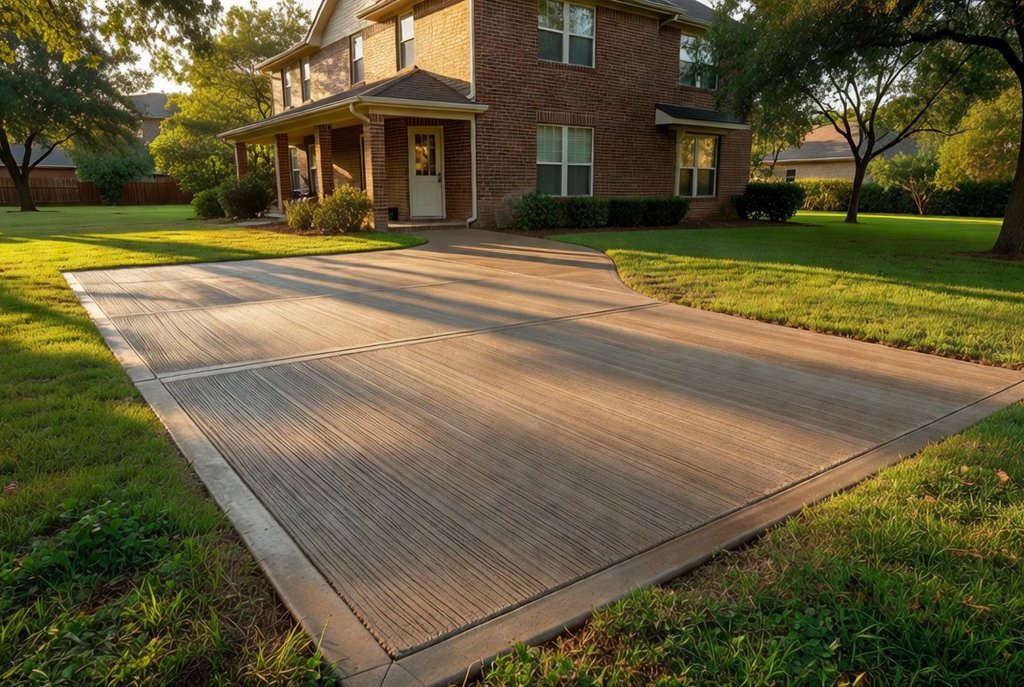
Here's the part contractors should say out loud and often don't: concrete cracks. The honest goal isn't a slab that never cracks — it's a slab that cracks where you decided it would. That's what control joints are. Cut at proper spacing, they give the concrete a weak line to relieve stress along, so you get a clean straight seam instead of a jagged fracture wandering across the middle of your patio.
If someone quotes you a slab and never mentions joints, ask about them.
Water Is the Long Game
A patio changes how water moves through your yard. You've just added a few hundred square feet of surface that absorbs nothing, and all of that runoff has to go somewhere. Slope it away from the house, and think about where the water lands once it leaves the slab.
This matters more here than most places. Water repeatedly soaking and then drying next to a foundation feeds exactly the soil movement that stresses slabs and homes. A lot of the drainage work we do — solid PVC drain lines, dry creek beds, regrading, rerouting downspouts — exists because runoff had nowhere good to go. It's worth solving while the yard is already torn up rather than two years later.
When Flagstone Is the Better Answer
We pour concrete and we lay stone, so we'll tell you honestly when one beats the other. Dry-laid flagstone is more forgiving on expansive clay — the individual pieces ride the soil's movement instead of fighting it, so the surface ages gracefully rather than fracturing. If you love the natural look anyway, or your spot has known movement problems, stone is a legitimately better fit.
Concrete wins on smooth, continuous surface, low maintenance, and furniture that doesn't wobble. Neither is the "right" answer in every backyard.
A Few College Station Specifics
- Newer subdivisions were often scraped flat and backfilled, so the ground behind a new-construction home isn't always the settled soil it looks like.
- Big live oaks are worth protecting. Pouring over a root zone is hard on the tree and eventually hard on the slab.
- HOA rules cover hardscape in plenty of neighborhoods here. Check before you form anything.
Straight Talk
Summer heat is real on a pour — concrete that cures too fast is more prone to cracking — so timing and technique matter in August in a way they don't in April. That's workable, not disqualifying.
Top-Notch Outdoor Services pours patios, pads, and driveways across College Station and the rest of the Brazos Valley. Tell us about your backyard and we'll give you an honest read on whether concrete or stone fits it better — no upsell pressure. Or call us at (979) 286-6555.