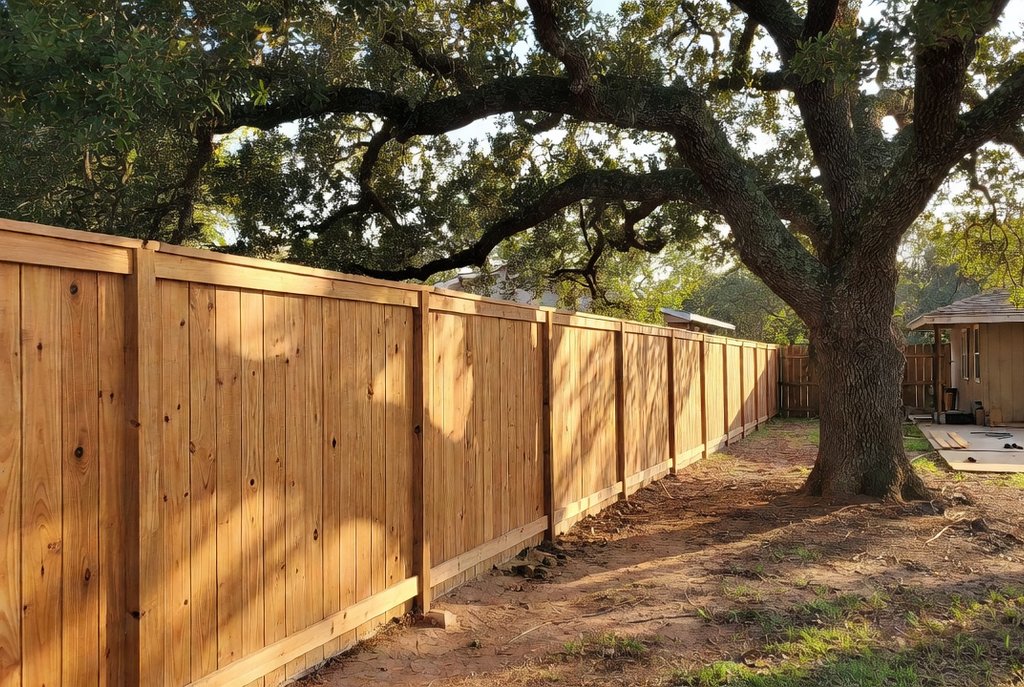
Bryan is our home turf, and we've built enough fences around town to know what separates one that stands straight for twenty years from one that's leaning within a couple of seasons. It almost never comes down to the boards you can see. It comes down to the part underground — the posts and how they're set in our clay.
Here's the honest version of what goes into a fence that lasts around here.
The Clay Is the Whole Story
Brazos Valley soil is expansive clay. It swells when it's wet and shrinks back down when it dries out, and we swing between both extremes — droughts followed by heavy downpours. That constant movement is exactly what heaves and leans a cheaply-set fence post over time. You can use beautiful boards and still end up with a wavy, tilting fence if the posts weren't anchored below most of that movement.
The fix isn't complicated, but it takes discipline: set posts deep, in proper concrete footings, so they're anchored below the zone where the soil does most of its swelling and shrinking. Get careful with post spacing and bracing so the whole run stays solid instead of relying on any single post. That's the unglamorous work that decides whether your fence is still square in ten years.
Picking a Material: Honest Tradeoffs
We install wood, chain link, and ornamental metal, and there's no single "best" — it depends on your budget and what the fence is for.
- Treated pine is the value option. It holds up fine when it's built and maintained right, and it stretches your dollar the furthest on a long run.
- Cedar costs more but looks better and has natural weather resistance that helps it stand up to our sun and humidity.
- Chain link is the practical, low-cost choice when you mainly need to contain a dog or mark a boundary rather than screen a view.
- Ornamental metal is the step up in looks and durability when appearance matters most.
Whatever you choose, our sun and humidity are hard on wood, so sealing the fence where it makes sense slows down the UV and moisture damage and buys you years. We'll walk you through the tradeoffs honestly rather than steer you toward the priciest option.
Gates Are Where Cheap Fences Show Their Age
A gate is the part of a fence that moves every single day, so it's the first thing to fail when corners get cut. Sagging gates almost always trace back to undersized posts or hardware that wasn't rated for the load. We set gate posts with that daily stress in mind and use hardware built to hold up, so the gate still swings clean and latches square after a few seasons instead of dragging in the dirt.
Before You Call Anyone
A couple of things worth sorting out before installation day, no matter who does the work:
- Property lines. Know where yours actually are before a post goes in the ground. A fence set over the line is an expensive, awkward thing to move.
- Utilities. Digging post holes means calling 811 to get underground lines located first. That's not optional, and it's free.
- HOA rules. A lot of Bryan and College Station neighborhoods have height, style, or material requirements. Check before you build.
Straight Talk
A fence is one of those projects where the money you save by cutting corners underground is exactly the money you'll spend fixing it later. Set right the first time, it just quietly does its job for decades.
Top-Notch Outdoor Services installs, repairs, and replaces fences all over Bryan and the rest of the Brazos Valley. If you're weighing a new fence, tell us about the project and we'll give you an honest read on materials and layout — no upsell pressure. Or give us a call at (979) 286-6555.