Drive south out of College Station along Wellborn Road and the yards change. Lots get wider, tree lines get longer, and a lot of properties sit somewhere between a suburban lawn and a small pasture. That's a good problem to have, but it makes mowing a different job than it is on a quarter-acre in town — and most of the advice you'll find online is written for the quarter-acre.
Here's how we think about mowing out this way.
Decide Where the Yard Ends
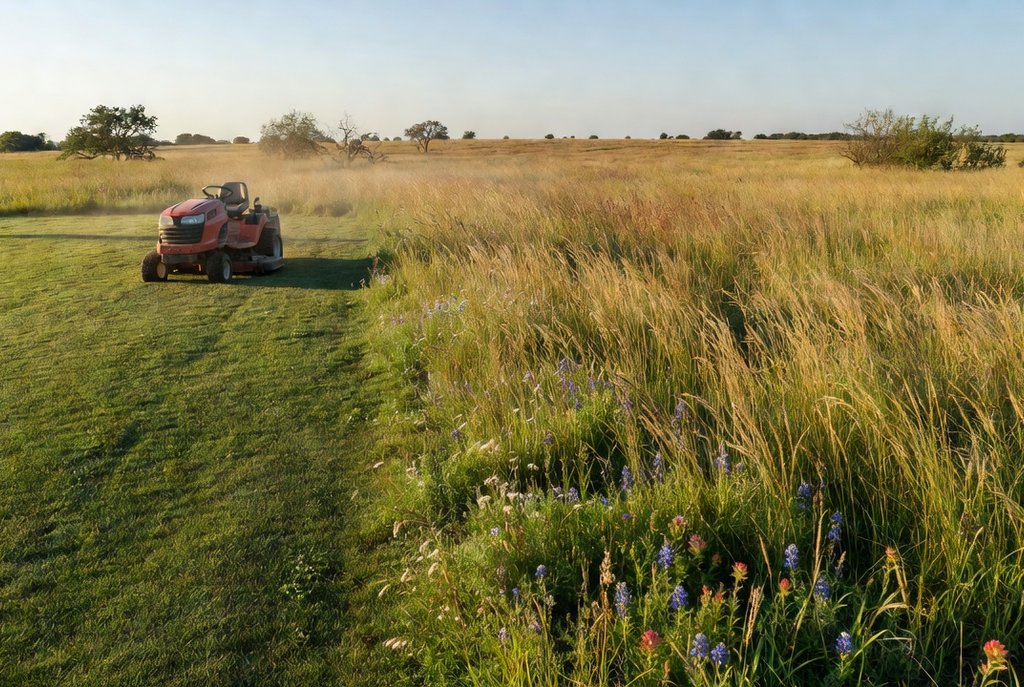
The single most useful thing you can do on a bigger Wellborn lot is draw a line — literally — between the part you keep as lawn and the part you keep as field. Lawn gets cut on a regular cycle at a consistent height. Field gets knocked down a handful of times a year so it doesn't turn into brush.
Trying to hold the entire property to lawn standard is how people end up mowing three hours every weekend all summer and resenting it. A clean, deliberate mow line around the house, the drive, and the areas you actually use looks intentional and finished. A half-hearted cut across five acres just looks tired.
Height Beats Frequency
Around here the fastest way to hurt a lawn is scalping it. Cutting short in July exposes soil that's already baking, dries out the root zone, and hands weeds an open invitation. Taller grass shades its own roots and holds moisture — which matters a lot on our clay, which takes water in slowly and gives it up fast once the surface cracks.
The working rule is to never take off more than about a third of the blade in one pass. If the grass got away from you, cut it high, wait a few days, and cut it again rather than dropping the deck and taking it all at once.
Time It Around the Rain, Not the Calendar
Brazos Valley clay doesn't drain fast, and a heavy mower on saturated ground leaves ruts you'll be looking at for a year. After a real downpour it's worth giving the ground a couple of days before you put weight on it, even if it means the grass gets a little long.
The flip side is our growing season is long and hard. From spring through early fall, warm-season grass out here can genuinely put on enough growth in a week to need cutting. Then it slows to almost nothing in the heat of a dry August and takes off again after the first good rain. A rigid every-Saturday habit will have you mowing dust some weeks and chasing hay other weeks.
Know What's in the Grass
Bigger, more open lots hide more. Fire ant mounds, old fence wire, buried stumps, dropped limbs after a storm, and washed-out low spots all live under tall grass, and they all find a mower deck eventually. Walk a new-to-you property before the first cut of the season and again after any big blow-through. It's ten minutes that saves a blade, a spindle, or a tire.
Keep the blade sharp, too. In our humidity, a torn grass tip is an open door for fungus, and it leaves the whole yard looking grayish no matter how straight your lines are.
The Edges Do the Heavy Lifting
On a rural lot, most of what makes a place look cared for isn't the middle of the yard — it's the edges. Crisp lines along the drive, around the mailbox and the porch, and a trimmed strip inside the fence line will do more for how the place reads from the road than another pass across the open ground.
When to Bring Someone In
Plenty of folks out here own a good mower and enjoy the work. Fair enough. Where it usually makes sense to call is when the acreage has gotten ahead of you, when you want the yard held to a schedule while you're traveling or renting the place out, or when a seasonal cleanup — beds, limbs, overgrown fence lines — is more than a Saturday's worth.
Top-Notch Outdoor Services handles lawn care across Wellborn and the rest of the Brazos Valley. Tell us about your property and we'll give you an honest read on what it actually needs — no upsell pressure. Or call us at (979) 286-6555.